
With numerous tools and APIs available, selecting the right rank tracking API can be overwhelming. It’s essential to choose one that not only provides accurate data but also aligns with your agency’s specific goals and operational needs.
This guide outlines the key factors to consider when choosing a rank tracker API. It will help you make an informed decision that enhances your SEO strategy and bolsters client trust.
1. Keyword Data Accuracy
A rank tracker is only as useful as the accuracy of its data. This makes accuracy the most important factor when choosing rank trackers for SEO agencies.
Like a weather app promising perfect forecasts, the keyword tracking space is filled with tools claiming to be the most accurate or having 99.9 percent accuracy.
However, relying on tools without verifiable data to support their claims can lead to inaccurate analysis and flawed performance reports, ultimately risking client trust and credibility.
How to Assess and Validate a Keyword Tracking API’s Accuracy
- Verify accuracy measures: look for tools that use data center rotation and proxies to access diverse, location-specific IPs to avoid biases from personalized results. These APIs should also use algorithms to detect anomalies to ensure a correct view of performance across languages, devices, and locations.
- Demand tangible proof: a reliable tool backs its claims with transparent, objective research reports. For instance, Keyword.com provides a report showing its near 97% accuracy rate.
- Check update frequency: accurate data depends on timely updates. With the rapid shifts in search engine rankings, a tool that updates only once daily may struggle to keep up.
- Ideally, your keyword tracking API should offer various refresh frequency options, including more granular updates like daily updates and custom refreshes for urgent situations, similar to what Keyword.com offers.
- Run Live Accuracy Test: compare the tool’s reported rankings against live Google SERP results. For example, the keyword “enterprise rank tracker” ranks in position one as shown in the keyword.com below:
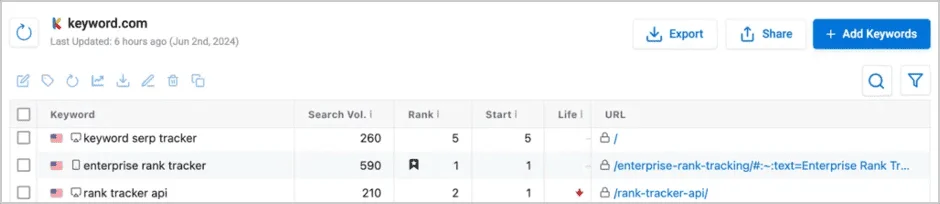
To validate this result, use a VPN to anonymize your search, switch to incognito mode, and enter your tracked keyword. The result for our example keyword shows that keyword.com matches the SERP result. Check out our rank tracker accuracy report for the exact testing process.
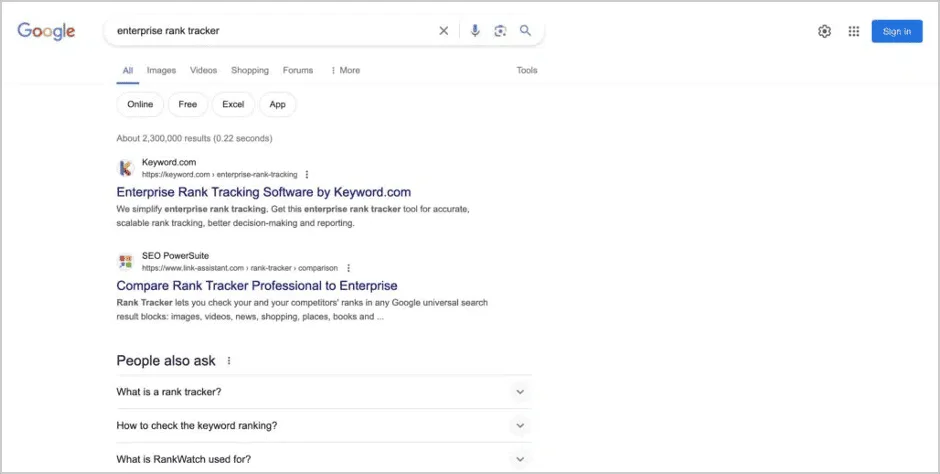
Note: Using this method for tools with lesser update frequencies may show discrepancies due to SERP volatility.
2. Prioritize API Features and Capabilities that Meet Your Goals
When choosing a rank tracker API, the features and capabilities available will impact the depth, flexibility, and value of insights you can gather.
However, rank tracker tools often have varying feature sets, some tailored specifically to rank tracking and others including broader SEO features. This can make it difficult to determine which tool is the best fit.
Hence, the easiest way to decide is by focusing on your goals. For instance, to improve local search visibility, find a tool that offers robust geographic targeting for local rank tracking.
In this case, your best choice is Keyword.com, which provides millions of residential IPs to give you accurate, unbiased data from country and city-level SERPs — without needing a VPN or GMB setup.
Key API Features to Consider Based on Your Goals Include:
- Real-time or custom updates: keeping up in competitive sectors where rankings shift rapidly demands real-time or scheduled data refresh options to provide accurate reporting.
- Device tracking: insights into user behavior across devices require API that can monitor rankings on both mobile and desktop, as this can reveal critical differences in ranking performance.
- Competitor analysis: competitive SEO strategy needs robust competitor tracking features to enable you to track competitors’ keywords, SERP features, and ranking changes to inform your approach.
- SERP features and visibility analysis: a comprehensive visibility strategy benefits from tracking keywords against SERP features like featured snippets, local packs, or “People Also Ask” boxes to give a well-rounded view of keyword performance.
- Historical data and trend reporting: ongoing campaign insight needs historical data to allow you to track your keyword performance trends over time, identify patterns, and fine-tune strategies based on past results.
- White label reporting: agencies reselling SEO services must prioritize white label reporting features to present reports under your brand identity, improving your professional look.
- Report scheduling: Keeping your client informed about ranking changes and insights requires a report scheduling feature, which enhances client communication and satisfaction.
By aligning the features of the rank tracker API with your objectives, you can choose a tool with maximum value to optimize your SEO efforts.
3. Consider Integration and Compatibility
A core benefit of using a rank tracker API tool is the ability to perform complex automation for faster and more accurate insights gathering, comprehensive performance reporting, and improved team efficiency.
However, the scope of your automation capabilities would depend on the range of integrations your keyword monitoring tools support.
For maximum benefit, choose a tool that integrates seamlessly with your existing tech stack and scales as you grow. By doing so, teams can access, analyze, and act on data within their preferred tools, promoting better collaboration and streamlined workflows.
Key Integrations to Prioritize in a Rank Tracker API
- Business intelligence tools: integrating with BI tools like Looker Studio and DashThis allows you to visualize ranking data alongside business metrics, providing a clear overview and easier analysis for strategic insights.
- Reporting tools: c onnecting rank tracking data with platforms like Google Analytics and Oviond enables you to aggregate your marketing tools’ performance data for a holistic view and comprehensive reporting.
- Competitive analysis tools: APIs integrating with tools like Google Search Console, SEMrush, and SimilarWeb allow you to combine rank tracking with competitor insights. This empowers you to make data-driven decisions to outperform the competition.
Most of these integrations are available on Keyword.com, but if the one you need isn’t, you may request a custom integration.
4. Ensure Ease of Use
Even with a skilled team of developers, an easy-to-use rank-tracking API can accelerate your outcomes. A testament to this is Steven Jadrell, CEO of Web Genius, who achieved a 900% increase in report creation using Keyword.com.
When selecting an API, don’t just focus on the features you want; consider the ease of setup. Look for a clear, intuitive interface with well-organized endpoints, parameters, and authentication details that are easy to locate and understand.
A bonus point if it offers detailed resources. For example, Keyword.com’s documentation includes code snippets, API call examples, and best practices, enabling developers to integrate the API in a few hours or days, depending on project requirements.
If you’re not tech-savvy, Keyword.com offers an embedded ranking table feature that allows instant implementation by adding links to your application, dashboard, or reports.
Finally, if your API must handle extensive keyword tracking, ensure it can manage high request volumes without compromising speed or performance.
5. Analyze Pricing and Cost-Effectiveness
You may be tempted to pick the lowest price per keyword when choosing a rank-tracking API.
But, to get the most value from your investment, it’s important to consider more than just the cost per keyword. Why? Some lower-priced APIs may lack essential features, while more expensive options might offer advanced functionalities that justify their higher cost.
This doesn’t mean you need the most expensive tool.
Instead, look for a pricing model that aligns with your actual usage — one that lets you pay for only the keywords you track and minimizes credit leaks that can drive up costs.
Keyword.com, for example, offers API-only pricing using a flexible pay-as-you-go model and a lower rate for higher keyword volumes to support your growth as you scale.
Unlike competitors, who often require separate calls for each data type, Keyword.com reduces expenses by consolidating data retrieval. It provides robust data — like search volume, search intent, SERP features, competition, clicks, impressions, click-through rates, visibility, and more—all through a single API call.
To further limit cost, Keyword.com stores your historical data, allowing you to access insights without transferring everything to your platform, except for data you want to keep beyond 30 days.
Also, it offers a consistent rate regardless of need. No extra charges for speed or data complexity.
Related: Search volume vs. intent vs. difficulty
6. Evaluate Support and Documentation Quality
While some rank-tracking APIs are easier to set up than others, there’s no guarantee the process will be completely seamless. This makes it essential to choose an API with reliable customer support that can assist with initial setup and quickly troubleshoot technical issues that may arise, minimizing downtime and disruption to your SEO efforts.
Good support is also valuable for clarifying specific functionalities and providing best practices for optimal use. This can help you avoid costly mistakes and ensure effective API use from day one.
Therefore, look for providers who offer multiple contact points, including live chat, email, and phone support, and respond quickly. With Keyword.com, for example, users enjoy responsive support, as one reviewer puts it:
“Customer support is also just a click away - and best of all - you can actually contact human beings.”
Also, ensure that your keyword monitoring API provider offers thorough, easy-to-understand documentation that guides you through the setup and empowers you to troubleshoot issues independently.
Lastly, be sure to check customer testimonials. Feedback from real users offers valuable insights into the quality of support and overall experience with the API.
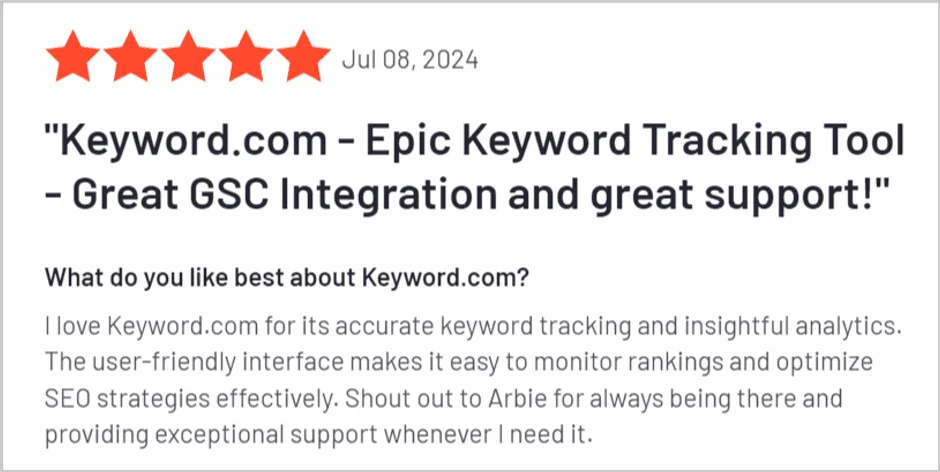
Here’s a testimonial from a Keyword.com user that shows our commitment to a valuable product and reliable customer support.
Choosing the Best Rank Tracking API
Use this checklist as your cheat sheet for choosing the right rank tracker with API to avoid trial and error and start reaping the benefits faster.
Focusing on key factors like data accuracy, feature flexibility, integration capabilities, ease of use, cost-effectiveness, and quality support can scale insights, streamline reporting, and optimize strategies based on reliable, real-time data.
For a solution that checks all these boxes, consider Keyword.com. If you’re ready to dive in, sign up today to fuel your agency’s growth and stay ahead in the SEO game.