How to Track Your Brand Mentions in Gemini AI Results (2026 Guide)
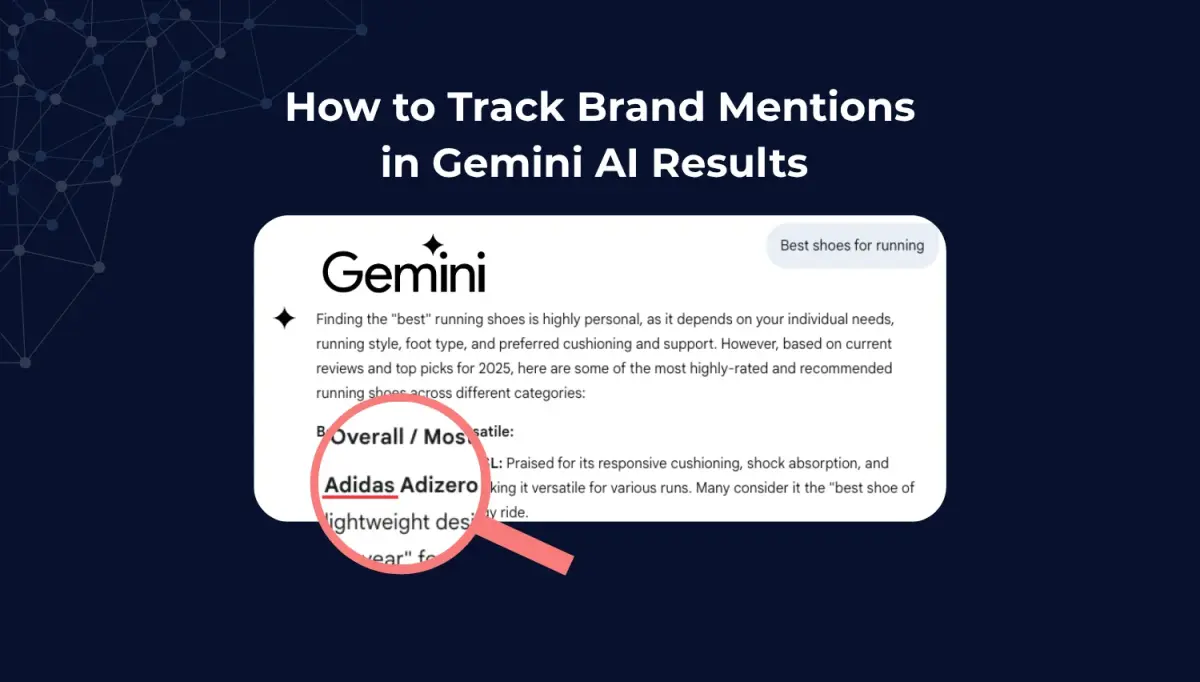
The world of SEO and Google is shifting from traditional blue links to AI-first search, and Gemini is at the center of that change.
If you want to track your brand mentions in Gemini, you can’t rely on normal rank tracking, impressions, or Search Console alone. Gemini powers AI Overviews, AI Mode, and a standalone chat experience, and it increasingly decides which brands to include or ignore based on relevance, authority, and helpfulness.
If Gemini isn’t mentioning you, you’re effectively invisible in one of the fastest-growing search channels.
This guide shows you how to track brand mentions in Gemini, measure Gemini rank tracking and AI visibility, understand why Gemini behaves differently from ChatGPT and Perplexity, increase your citations using Answer Engine Optimization (AEO), and use Keyword.com’s Gemini AI visibility tracker to monitor rankings, sentiment, and citations.
TL;DR: How To Track Gemini AI Mentions and Rankings
- Use an AI visibility tracker (like Keyword.com); traditional rank trackers can’t see generative answers.
- Add your brand, website, and key prompts (e.g., “best tools”, “ vs ”).
- Select Gemini as a tracked platform (including AI Overviews and AI Mode).
- Set a tracking frequency (daily/weekly/monthly).
- Monitor AI visibility score, sentiment, prompt-level inclusion, and citations. Then optimize your content and authority where you’re missing.
Step-by-Step Guide for Tracking Gemini Results Using Keyword.com
AI search doesn’t generate normal SERPs. There are no positions 1–10, no impression logs, and many mentions appear without clicks. That means Google Search Console cannot show you the full picture of how Gemini uses (or ignores) your brand.
To track Gemini visibility, Gemini keywords, and Google AI Mode or AI Overviews rankings, you need an AI rank tracking tool that looks directly at the outputs of Gemini’s answers. Tools like Keyword.com, Peec.ai, and Rankscale can do this; here’s how it works in Keyword.com.
Step 1: Sign Up for AI Visibility Tracker
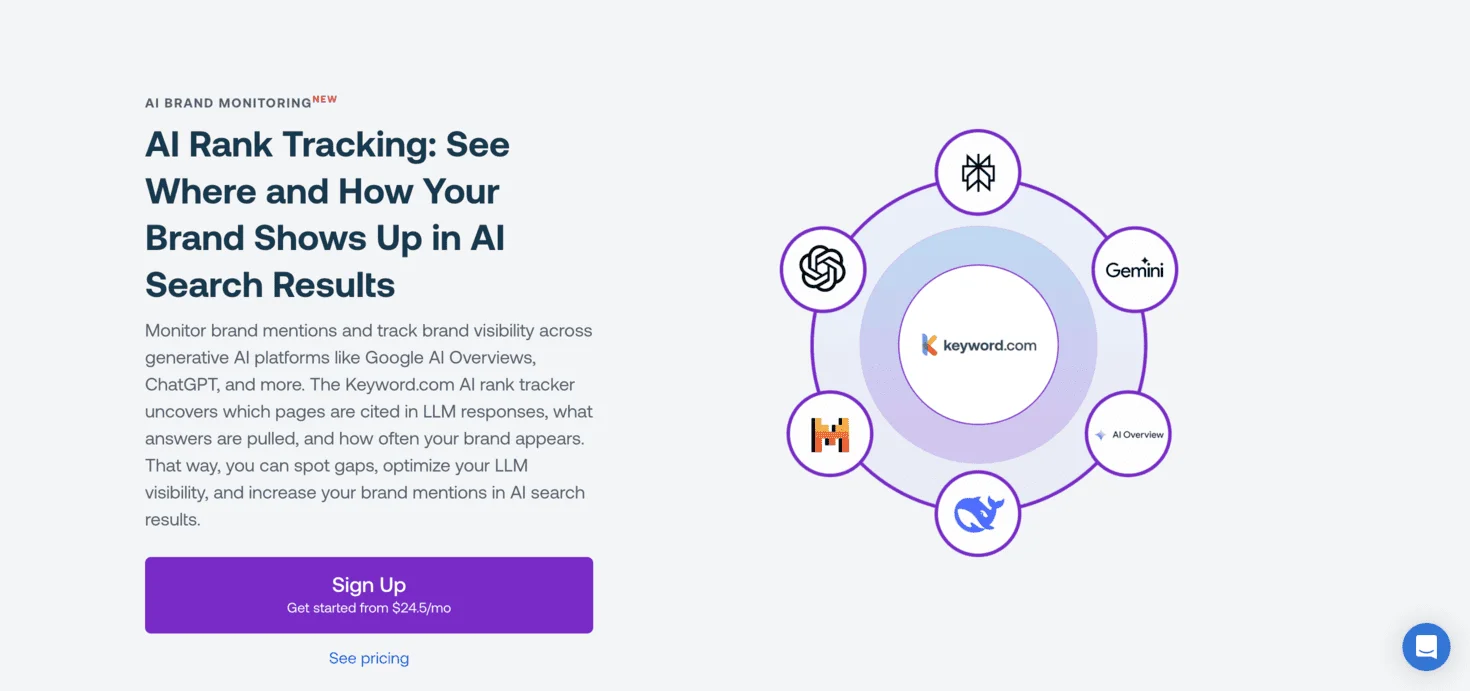
Visit Keyword.com and create an account. Head to the AI Visibility section in your dashboard.
This is where you’ll configure tracking for Gemini, AI Overviews, AI Mode, and other LLMs like ChatGPT and Perplexity.
Step 2: Add Your Website and Brand Terms
Add:
- Your website URL.
- Your brand name and variations.
- High-intent prompts and queries you care about, such as:
- “best keyword rank tracking tools” - “keyword gemini ai” - “alternatives to ” - “ vs ” - “best ways to track brand mentions in AI search”
You can also add broader Gemini keywords like “Gemini AI rank tracking” or “AI mode keyword rank tracker” to see when you’re mentioned in more generic AI search questions.
Step 3: Select Gemini as a Tracked Platform
In the AI Visibility settings, choose Gemini as one of your tracked AI engines. Keyword.com supports:
- Gemini chat.
- Google AI Overviews.
- Google AI Mode.
You can track Gemini alone or alongside ChatGPT, Perplexity, Claude, and AI Overviews to see how visibility differs across platforms.
Step 4: Set a Tracking Frequency
Choose how often you want Gemini visibility metrics refreshed:
- Daily: good for active campaigns, feature launches, or sudden visibility shifts.
- Weekly: good for ongoing monitoring across multiple brands or clients.
- Monthly: good for long-term trend analysis.
Save your settings to start collecting data.
Step 5: Analyze Your Gemini Report
In your Keyword.com AI Visibility report, you’ll see:
- AI mention frequency: how often you’re named in Gemini results.
- Sentiment score: whether your brand is framed positively, negatively, or neutrally.
- Prompt-level rankings: which queries surface you vs. competitors.
- Citation sources: which pages Gemini pulls from when recommending your brand.
You can also benchmark against competitors to see where you’re gaining or losing ground.
What is Google Gemini?
Gemini is Google’s AI-powered assistant and search engine, combining conversational AI with traditional search signals. It powers:
- AI Overviews in Google Search.
- AI Mode (full-screen conversational search experience).
- The standalone Gemini app.
Instead of returning a simple list of links, Gemini:
- Understands user intent using large language models (LLMs).
- Pulls data from the live web and Google’s index.
- Generates conversational answers.
- Sometimes cites sources, sometimes just summarizes.
Key Gemini Features
- AI Overviews in Search: Google’s new default experience for many queries.
- Conversational follow-ups: users can ask clarifying questions right from the SERP.
- Contextual citations: Gemini sometimes links to sources, but often summarizes without attribution.
- Integration with Google services: Gemini is embedded across Gmail, Docs, Chrome, and more.
Gemini is no longer a side experiment. It’s wired into how Google expects users to discover, compare, and decide.
Related: How to track Google AI Overviews
How Does Gemini Work?
Gemini uses Google’s latest large language models to answer queries in natural language. It pulls from a wide range of sources, including web content, structured data, and user interactions.
The assistant prioritizes relevance, authority, and helpfulness, similar to traditional Google search but with enhanced synthesis. Often, Gemini includes links or brand mentions without requiring users to scroll down to organic results, making it crucial for brands to monitor their visibility.
When a user searches with Gemini or triggers an AI Overview in Google Search, here’s what happens:
- The query is interpreted: Gemini uses a large language model (LLM) to understand user intent, even if the question is vague or open-ended.
- It fetches fresh data: unlike ChatGPT-3.5, Gemini searches the live web to generate real-time answers. It pulls content from trusted sources, structured data, and Google’s own index.
- It synthesizes the answer: Gemini distills key points from multiple sources into a conversational answer. Sometimes, it adds brand names, product recommendations, or how-to steps.
- It decides what to show: Gemini chooses which brands to reference and which to leave out based on helpfulness, relevance, authority, and clarity.
- It displays an AI Overview (optional): for standard search users, Gemini powers the AI Overview at the top of the SERP, often pushing organic listings further down the page.
Why Tracking Gemini Requires A Different Strategy Than ChatGPT Or Perplexity
Gemini behaves differently from other AI search engines in a few important ways:
- Connected to Google’s index: Gemini leans heavily on Google’s real-time crawling and ranking systems.
- Blended SERP and LLM logic: AI Overviews and AI Mode mix traditional SEO signals with generative reasoning.
- Clicks vs. mentions: you might be mentioned in an answer but receive no click, which GSC can’t see.
- Multiple surfaces: Gemini influences AI Overviews, AI Mode, and responses across Google’s ecosystem.
Perplexity runs its own real-time search engine. ChatGPT mostly uses pre-trained data plus optional browsing. Gemini is uniquely positioned as “AI on top of Google”, so tracking it needs a dedicated Gemini visibility tracker, not just standard AI monitoring.
What Factors Influence Your Visibility In Gemini
Gemini looks at more than just who ranks #1. To decide whether to mention or recommend your brand, it tends to favor content and domains with:
- Clarity: direct, well-structured answers to user questions.
- Authority: trusted domains, subject-matter experts, strong backlinks.
- Freshness: updated and maintained content, not stale pages.
- Structure: FAQ sections, headings, schema, lists, tables.
- Topical depth: consistent coverage of related subtopics, not one-off pieces.
Think of it as a hybrid of traditional ranking factors + answer-engine needs. If your content is vague, outdated, or hard to parse, Gemini will almost always pick a competitor that’s clearer and more structured.
How to Rank in Gemini: Answer Engine Optimization Tactics
Tracking is just the start. To improve how often (and how well) Gemini mentions your brand, use these answer engine optimization tactics:
1. Answer Specific Questions Clearly and Directly
Gemini is prompt-driven. Its responses are based on how well content matches the user’s intent, not just keyword inclusion.
What to do:
- Create content around high-intent, natural-language prompts (e.g., “What is technical SEO?”, “How to optimize internal links”, “Best tools for keyword research”).
- Use question-based H2s and H3s throughout your content to mirror likely queries Gemini will try to answer.
- Start your content with a direct, one-sentence answer, then expand with details, examples, or frameworks.
Why it works: Gemini scans for concise, well-structured answers it can quote or paraphrase. If your page clearly answers the exact question a user asks, you increase your odds of being cited.
2. Use Structured Data to Signal Relevance
Schema markup doesn’t just help traditional search. It helps LLMs like Gemini parse your content more confidently and extract structured facts.
What to do:
- Use FAQ schema for common questions and HowTo schema for step-by-step content.
- Add Product schema to key product/service pages, including reviews, pricing, and specifications.
- Include Article or WebPage schema with author names, publish dates, and relevant metadata.
Why it works: While Gemini may not rely on schema alone, it uses structured data to verify accuracy and relevance. Schema helps reinforce that your page is authoritative, fresh, and trustworthy, boosting your chances of being used as a reference.
3. Format for Easy AI Parsing
Even the best content can be skipped if it’s hard for Gemini to parse. Large blocks of text, unclear headings, or buried answers reduce your chance of being cited.
What to do:
- Keep paragraphs short; ideally, 2–3 lines.
- Use bullet points for lists, comparisons, or key takeaways.
- Bold, important insights and one-liners that answer the question directly.
- Include a quick summary at the top or bottom of your post (“In summary…” or “TL;DR”).
Why it works: Gemini often looks for content it can cleanly extract or summarize. The more “scan-friendly” your page is, the more likely it will be surfaced in a response.
4. Build Content Clusters Around Core Topics
Gemini looks for topical authority. It’s more likely to cite a brand that consistently publishes helpful content around a subject, not just one isolated blog post.
What to do:
- Choose a core theme (e.g., local SEO, B2B email marketing, small business finance).
- Create a hub page that serves as the pillar or ultimate guide.
- Build 5–10 supporting articles that explore subtopics, tools, methods, or FAQs.
- Internally link between pages using natural anchor text.
Why it works: When Gemini sees your domain repeatedly mentioned in different contexts across the same topic, it’s more likely to treat you as an expert—and pull your brand into related answers.
5. Build External Authority and Get Cited Elsewhere
Gemini doesn’t just pull information from your site. It sources information from across the web, especially review sites, forums, third-party blogs, and high-trust publications.
What to do:
- Earn brand mentions on trusted review platforms, industry blogs, Reddit, and Quora.
- Collaborate on guest posts and product roundups.
- Get listed on niche marketplaces or curated resource lists in your industry.
Why it works: Even if Gemini doesn’t pull directly from your site, appearing in content it trusts improves your chances of being cited. Third-party validation signals legitimacy and relevance from multiple angles.
Track Brand Mentions in Gemini with Keyword.com’s AI Monitoring Tool
Keyword.com’s AI Visibility Tracker is built for the reality of AI-first search. It helps you:
- See where and how often Gemini mentions your brand.
- Track AI visibility metrics across Gemini, AI Overviews, AI Mode, ChatGPT, Perplexity, and more.
- Monitor sentiment and competitor mentions.
- Identify which prompts and queries you’ve won, and where you’re missing.
Instead of guessing how Gemini sees you, you get real data, so you can adjust your content, authority, and positioning with confidence.
Sign up for AI Visibility and start tracking your Gemini rankings and mentions today.